INTODUCTION
Dear friends and readers, in today’s rapidly evolving world, there is an undeniable surge in public resentment and misconceptions surrounding core sciences –in the last, at least, 20 years, especially now during the first 21st [1] century pandemic event. On the one hand it is crucial for us to foster a deep understanding of scientific endeavors, their significance, and the rigorous process of scientific inquiry. On the other, it is truly alarming to witness the widespread ignorance and misuse of scientific knowledge. The glaring lack of understanding of natural processes and misuse of correlation and causation is not only concerning but downright infuriating. It seems that we are careening towards a society reminiscent of the dystopian film Idiocracy [2], with dire consequences looming over us. The sooner we address this issue and learn what scientific literacy means, the better chance we have at avoiding the impending catastrophe that surely awaits us. I would like to think that the needed level of scientific literacy in general has not been completely lost, which allows us to approach and tackle real-world issues from a scientific standpoint. However, the task of identifying and defining the underlying patterns of this emerging social problem proves to be challenging. Initiating a thought-provoking discourse on this matter is of utmost importance, as the issue of scientific illiteracy amongst a significant portion of the population prevails, including individuals with a higher education background. I understand that the latter part of this observation can sometimes lead to disagreements and potential misconceptions. My intention is not to engage in ad hominem attacks or undermine the intelligence of individuals in any field. Rather, I aim to address the irrational interpretations of reality among scholars and scientists. It is also often assumed that scientific literacy and critical thinking are interchangeable, yet they are distinct concepts. In the text below, I will elucidate this distinction. It is worth noting that individuals may excel in critical thinking in certain subjects while lacking scientific literacy in others, as well as in general. It is not uncommon to encounter highly educated individuals who may be scientifically illiterate. I anticipate that such claim may provoke differing perspectives. Moreover, I would like to differentiate between those who have not had the opportunity to become scientifically literate despite their education, and those who have had the opportunity but have not fully embraced it.
Short excurse about core sciences
I propose a distinction between (real) scientific and academic (as narrow interpretation of the term “academic”) disciplines, highlighting the academic’s capacity to generate fundamental and transformative data primarily on their own, without relying heavily on other fields. Additionally, a critical aspect is their ability to forecast outcomes without immediate assistance from external scholar domains. Such differentiation serves to underscore the autonomous nature and unique contribution of these disciplines.
When discussing scientific disciplines, it is imperative to underscore the significance of core sciences, namely mathematics and natural sciences, including physics, chemistry, and biology with their respective subfields. These disciplines are deemed genuine sciences due to their intrinsic ability to generate explanations for natural phenomena and formulate independent predictions, without necessitating immediate input from other scientific domains. Furthermore, they serve as the bedrock for other academic pursuits, with physics acting as an applied branch of mathematics, chemistry as an applied form of physics, and biology as an applied field of chemistry. This comprehension elucidates the interconnectedness and mutual dependence among each core science.
Under academic disciplines, I understand all current social and applied sciences. Their paradigm-changing discoveries always depend on (real) sciences, as some of them lack the ability to produce exact long-term empirical prognosis and mathematically based explanations by themselves. The research of new frontiers is therefore always dependent on what [core] science provides as a starting point. For instance, applied and social “sciences” primarily use existing scientific knowledge for practical goals and explanations [applied: for technology or inventions; social: for the explanation of human interactions].
It is important to acknowledge the significance of social and other academic disciplines, even if they should not be classified as core sciences. Understanding their roles and how groundbreaking discoveries are made is crucial. Equally important is recognizing the interdependencies between various disciplines and their levels of abstraction. By appreciating these aspects, we can gain a comprehensive understanding of the scientific landscape.
In considering this question, the classification of academic activities within universities shows it’s importance too. Specifically, the query arises as to whether these activities should be categorized as faculties or alternatively, under a different designation. In accordance with my proposal, I advocate for reserving the term “faculty” exclusively for the scientific disciplines. Conversely, other academic fields would be more appropriately situated under the designations of a college or an academy, contingent upon their primary focus of research. Should the discipline predominantly revolve around social sciences such as law, politics, linguistics, or economics, an academy would be the suitable classification. Conversely, disciplines that are primarily applied, such as technical or medical fields, would find their place under the designation of a college.
I understand that my colleagues, who are esteemed social scholars, may hold contrasting opinions and may vehemently challenge my proposals. Nonetheless, their views are subjective and based on personal inclinations rather than on objective and well-founded arguments. One cannot disregard the questionable decisions, be they non-scientific or politically motivated, that have led to the classification of theology as a scientific discipline in certain instances. These decisions merit scrutiny, as they often hinder the application of the scientific method in various domains where its implementation could offer a clearer and more systematic approach. As an individual with a background in social sciences, it is unjustifiable to claim that my stance is driven by animosity towards social disciplines or a preference for the natural sciences.
Even individuals who have achieved recognition in the scientific community can easily display a lack of scientific literacy when it comes to certain topics, including whithin their own field. This includes renowned scientists and scholars who, despite benefiting from scientific research and development, may hold misguided viewpoints. One such example is the presence of scientifically illiterate arguments, such as those often found within religious apologetics. Human beings possess an innate inclination towards irrationality, a characteristic that should not necessarily be regarded as wholly negative. Rather, it can be understood as a natural consequence of our evolutionary development, serving to sharpen our primal survival instincts in certain circumstances. Nonetheless, when irrationality becomes excessive, it can lead us to succumb to fallacious reasoning, unfounded fears, and biased ideological influences. Such tendencies tend to thrive under conditions of fear and ignorance, exerting a powerful influence on our thoughts and actions – usually dormant during non-stressful times [e.g.: absence of conflicts, existence of well-organized social security, absence of natural disasters, etc] and make them very much potent when is the opposite the case [e.g.: war, diverse social insecurities, natural disasters, etc]. Lack of understanding regarding the fundamental laws of nature [3], whether it be in the realms of physics, chemistry, or biology, can significantly contribute to our apprehension of the unknown. This often leads us to embrace unverified claims and adopt them as established scientific facts. Unfortunately, this type of thinking can pave the way for susceptibility to demagoguery, as well as the acceptance of empty rhetoric and illogical arguments.
Before I write any further I would like state some facts about myself first:
I have no formal completed higher education in natural sciences. The fact that I have attended an energy production electrical engineering high school and pursued the study of astronomy, as well as my family’s background, is predominantly in natural or applied sciences. However, I decided not to count this as a relevant scientific influence. This fact, however, does not weaken or have anything to do with the argumentative basis of the topic I am about to address. I am talking about the basic foundations for how to recognize a scientifically literate person and how to be scientifically literate yourself, especially concerning subjects that have a strong connection with natural sciences. These abilities do not form during higher education but during our elementary education, even during childhood. Therefore, any higher academic competence is irrelevant in this regard. It can be helpful, yet it cannot be used as the prime argument.
I am a very passionate amateur scientist who is constantly searching for ways to improve the above-mentioned abilities, and I strive to learn how to recognize my own argumentative fallacies and pseudoscientific stances. In this respect, I will not pretend to be a chemist, physicist, or biologist. Yet, being scientifically literate does not imply being ultimately well-read in these fields, as I will try to show in the coming text, but rather understanding the general principles according to which something is likely to occur, or be plausible, or be scientifically true.
Condensing the points above, I would like to conclude that acquiring formal higher education does not automatically imply the acquisition of scientific literacy. There are many aspects that prevent a highly educated person from being scientifically literate, even if one possesses multiple doctorates!
In order to explain the rationale behind these “self-descriptions,” it is important to address the issue of handling criticism or suggestions. It is unfortunate that, instead of engaging in factual and logical rebuttal, the usual response I encounter tends to involve ad hominem counterarguments and attempts to discredit my formal competencies in the relevant subject matter. This type of argumentative fallacy is something that I will address later on. Often, this paradox arises from individuals who may be scientifically illiterate but hold unwarranted confidence in their knowledge. This attitude is, in fact, one of the manifestations of scientific illiteracy – a refusal to accept criticism and acknowledge the possibility of engaging in fallacious reasoning. Therefore, to preemptively address any unrelated refutations, I provide a description of my formal competencies. However, it is important to emphasize that welcoming well-founded factual criticism and scrutiny is fundamental to the scientific way of thinking, and I am fully open to it.
Susceptibility to nonsense. Why? – no one is excluded!
Please allow me to begin with the following quote from astrophysicist Neil deGrasse Tyson:
“Scientific literacy is an intellectual vaccine against the claims of charlatans who would exploit ignorance”.
Scientific literacy encompasses a fundamental understanding of scientific concepts and the ability to critically evaluate scientific information. It is important to differentiate between levels of reasoning, namely common sense, critical thinking, and scientific literacy. Scientific illiteracy refers to a lack of knowledge and/or lack of understanding of general scientific concepts about any topic one would like to address. As mentioned, even those with higher education may not necessarily possess a scientifically literate mindset. Therefore, assuming that advanced education automatically results in scientific literacy would be an inaccurate assumption and a logical fallacy.
Common sense is an invaluable cognitive asset that plays a significant role in our daily lives. It enables us to navigate the complexities of the world around us and make sense of various phenomena. This type of reasoning, deeply ingrained within us, is a fundamental aspect of our evolutionary development and is often founded upon our own personal experiences. However, it is important to recognize that common sense is highly subjective and can vary greatly from person to person. While certain experiences may be shared among individuals, it is essential to approach conclusions drawn from common sense with caution, as they may not necessarily align with scientific evidence and rigorous analysis. Common sense can sometimes lead us astray, particularly when it comes to making assumptions based on correlation rather than causation. Additionally, common sense should not be confused with critical thinking, as they are distinct concepts. It is not uncommon to encounter situations where the invocation of common sense is emphasized, but it is crucial to differentiate between common sense and rigorous logical thinking. In exploring the intricacies of the natural world, particularly in realms beyond our immediate perception, relying solely on common sense can often prove inadequate. Renowned mathematician and physicist Stephen Hawking eloquently encapsulated the nature of common sense by stating: “Although our apparently common-sense notions work well when dealing with things like apples, or planets that travel comparatively slowly, they don’t work at all for things moving at or near the speed of light”.[5]
Common sense is easily influenced by superstition and personal beliefs, which can lead to oversimplification of complex issues. Take, for instance, the topic of electromagnetism and its potential health impacts. It is common for people to confuse electromagnetic radiation (EMR) with electromagnetic fields (EMF), mistakenly considering them as one and the same. When discussing the concept of “lethal radiation” associated with different electrical devices, there tends to be a significant amount of confusion and misunderstanding regarding which forms of radiation pose actual risks and which sources emit higher levels of energy (measured in Watts per square centimeter). For example, a prevalent belief suggests that any WiFi electromagnetic wave has the potential to adversely affect health. Such unfounded assumptions lead us to intuitively perceive all radiofrequency (RF) electromagnetic waves as more dangerous compared to, for instance, infrared (IR) waves (heat). However, it is crucial to critically examine why this way of thinking persists.
In the realm of electromagnetic radiation, the perception of heat differs due to our unique evolutionary adaptation. Human beings have developed a sensitivity to heat and it is a familiar and tangible sensation comparable to e.g. radiofrequencies. On the other hand, both infrared (IR) radiation and radio frequency (RF) waves fall under the category of non-ionizing electromagnetic radiation and are generally considered safe under normal conditions. It is important to note that IR radiation possesses a higher energy per photon compared to other low-frequency EM waves, such as RF waves, making it more capable of causing burns and damage when amplified. Consequently, it is not advisable to place one’s hand on a hot stove, where concentrated IR radiation is present. Conversely, it is generally safe to touch and be surrounded by WiFi routers emitting RF waves. It is often our common sense and daily experiences that can lead us astray when making judgments in this domain.
Critical thinking is an essential skill that delves into the intricacies of human reasoning. It encompasses a profound and meticulous examination of subjects within a particular scientific or thematic domain. In addition to a comprehensive understanding of relevant scientific data, critical thinkers possess a keen awareness of their potential cognitive biases and dissonances within the field. By harnessing the power of critical thinking, individuals can elevate their reasoning abilities to new heights, enabling them to navigate complex intellectual landscapes with confidence and precision. Proficiently questioning matters within our primary field of interest is a valuable skill. However, when venturing into unfamiliar scientific territories, it is crucial to approach the subject matter with utmost care and open-mindedness. Without this awareness, we may unintentionally succumb to erroneous assumptions rooted in common sense. As a result, our cognitive faculties may rely on personal beliefs rather than objective facts and rational analysis. It is imperative to recognize this inclination and prioritize evidence-based reasoning and rigorous comparative analysis in our exploration of diverse scientific domains. It is fairly common for individuals to possess a lack of scientific understanding and knowledge, and this can impact a greater number of people than we might initially think. Even esteemed figures, such as Immanuel Kant, were known for their exceptional intellectual abilities and profound insights into political and ideological matters. However, Kant’s understanding of natural processes and medical advancements during his time was somewhat limited, leading to certain ideas that may appear unconventional when viewed in the context of modern times. This lesser-known aspect of Kant’s persona adds an intriguing layer to his legacy. While it is true that critical thinking is a crucial component of scientific literacy, it is important to recognize that these two elements are not necessarily synonymous.
Scientific literacy goes far beyond critical thinking. It is a multifaceted skill that shines brightest in the minds of children. In fact, I consider it to be a prime cognitive ability. And how did I arrive at this conclusion? As an educator who frequently interacts with children, I have had the privilege of witnessing their natural curiosity and the way in which they approach asking questions. It is fascinating to note that children often pose their inquiries without assuming a particular answer and without attempting to fill any gaps in their knowledge with superstition, preconceived notions, or personal experiences. Their open-mindedness and willingness to explore new ideas serve as an inspiration for fostering a serious and thoughtful approach to learning. Most children tend to lose or suppress this cognitive ability before reaching adulthood (e.g. crippled educational system, religious schools, political indoctrination, etc.), which significantly impacts their later cognitive reasoning abilities. As a result, their reasoning often remains limited to common sense or, if they are fortunate, focuses on specific aspects such as critical thinking in a particular field. If scientific literacy somehow survives until adulthood and subsequently gets cultivated, I could describe such an ability as a polymathic capacity to simultaneously recognize basic aspects – such as basic questions, systems, factually related references – and the overall importance of any topic or science we want to discuss. It also entails the ability to recognize self-inflicted confirmation bias and cognitive dissonance. There are various interpretations of science literacy. One that I find particularly appealing states: “Science literacy is the knowledge of key science concepts and the understanding of scientific processes. This includes the application of science in cultural, political, social, and economic issues. All of these areas are ever-changing landscapes in today’s world.“[6]
Being scientifically literate empowers individuals to analyze and interpret information effectively. Consider the following scenario: witnessing a catastrophic plane crash with many potential fatalities. Our initial common sense reaction might be rooted in instinctual fear, leading to a reactionary conclusion such as, “We must avoid flying as it is dangerous!” However, employing critical thinking skills allows us to delve deeper. Realistically, statistics reveal that flying is among the safest modes of transportation. Yet, it is crucial to investigate the precise circumstances surrounding the incident to gain a comprehensive understanding. In order to approach the claim in a scientifically accurate manner, one would consider several key factors. Firstly, it is important to ascertain the specific dimensions and purpose of the aircraft in question. Is it comparable to a large-scale aircraft such as an Airbus A380, Antonov An-225, or a postal service DC-10? Additionally, when stating that many passengers were probably killed, it becomes crucial to analyse supporting evidence for such a claim. Factors such as the aircraft’s passenger capacity, actual presence of passengers, and credible sources and a well-defined point of reference must be taken into account. Scientific literacy encompasses an additional layer of cognitive thinking that sets it apart from other types of cognition. It offers a unique perspective and approach to understanding the world, especially in specific cases where other forms of thinking may not apply.
The differentiation between causality and correlation is essential in practical situations, going beyond usual philosophical understandings of these two terms. Having a grasp of basic concepts related to probabilities enables individuals to make informed decisions. For instance, when someone asserts that the use of a particular medication caused medical problems in their friend, spouse, or child, and therefore concludes that the medication is inherently dangerous for everyone, it is imperative to recognize the logical and argumentative fallacies present in such a statement. All these aspects are part of a scientifically literate way of thinking, and not necessarily part of the mentioned other two.
- To use one’s own experience or the experiences of other people with the same characteristics as a benchmark in this case is plain and simple anecdotal evidence. On the other hand, if I included those patients with no effects and then made a statistical analysis, such a statement would be more objective, yet without proper laboratory analysis, it would still be very vague.
- Even if such a claim came from a physician, it would still be anecdotal evidence and more likely an argumentative fallacy known as an argument from authority (argumentum ad verecundiam) as well.
- The claim confuses correlation for causation and vice versa. Just because something occurs at the same time as another occurrence does not imply that the prior one is immediately causal for the latter. As mentioned before, in order to be sure that the claim has merit and to successfully apply the theory of probabilities to future cases, one has to gather relevant factual data to compare. And, in the end, the following point:
- Too often, there is factual data that shows how and in what respect something can be or could be dangerous. However, if a person has a strong confirmation bias toward a pseudoscientific claim, as well as support from a physician of one’s “choosing” who underlines such bias, there is practically no chance of convincing that person otherwise. What we usually see is the cherry-picking of such data and the misinterpretation of the given results that conform to the bias itself.
When examining such claims, it becomes evident that they do not withstand factual scrutiny. Once these claims are thoroughly debunked, the claimant must acknowledge their lack of scientific literacy. It is important to clarify that possessing critical thinking skills in one area, such as law, does not automatically translate to being scientifically literate in general. I am speaking from my own experience, so there is my own anecdotal evidence for this! 😉
A few more examples:
The issue of plastic pollution is a matter of grave concern. It is an undeniable fact that human activities have significantly contributed to the pollution and littering of our planet. However, it is crucial to acknowledge that ongoing research continues to shed light on nature’s remarkable ability to adapt and respond to these environmental challenges within the broader context of evolution. According to common sense, some would say that pollution destroys nature, yet others would claim otherwise. That is the problem with common sense. It offers a wide range of subjective claims that mutually negate themselves, which are also too often not in accordance with presented scientific data. According to people who are thinking critically in this field, the problem itself would be analyzed factually, and the conclusion would be pretty much like “We are destroying nature“. The scientifically literate individual would, however, very much try to include possible and ongoing long-term evolutionary aspects into calculations, as well as whether we possess the ability to destroy the nature [planet] and life at all. What does this mean? Well, when it comes to envisioning the future, humans often find it challenging to think beyond the scope of their immediate surroundings and the familiar timescales of their existence. As creatures bound by the constraints of our perception, we tend to focus on short-term planning and present-day concerns. Considering the complexities of foreseeing events that lie far beyond the predictable timespans, it becomes evident that our ability to effectively plan for the long-term remains limited. Our track record in preserving and safeguarding our environment, for instance, reveals the gaps in our foresight and the urgent need to enhance our capacity for sustainable decision-making.
Ongoing preconceptions about the subjects at hand significantly influence the entire thought process as well. In the aforementioned example, an individual with a strong scientific background would not be inclined to adhere rigidly to preconceived notions regarding our impact on pollution. It is essential to acknowledge our undeniable involvement in environmental changes, without denying or trivializing it. However, such an individual would take a more comprehensive approach, considering long-term evolutionary factors that could potentially offer solutions to the issue, irrespective of human influence, and keeping their minds open to future research. Within this framework, one could hypothesize the potential emergence of microscopic life forms capable of digesting plastic or oil, taking inspiration from the well-documented ability of certain bacteria, such as Alcanivorax borkumensis, to metabolize hydrocarbons. Our attempts to “pollute” the environment inadvertently prompt Mother Nature to respond by fostering adaptation in various microbial species, which might eventually incorporate our waste into their natural ecosystem.
The well-known science communicator and videocaster, Anton Petrov [7], drawing from his vast array of scientific knowledge, confidently sheds light on the captivating phenomenon of human interference giving rise to groundbreaking evolutionary changes in both the microscopic and macroscopic domains. A particularly intriguing facet of this transformation is the remarkable adaptation of minuscule organisms, as they ingeniously employ plastic for a multitude of purposes, showcasing their exceptional resilience in an ever-evolving world [8] You know what would be absolutely wild? Picture this: a gang of plastic-eating bacteria on the loose, devouring all the plastic in their path!
We have the incredible power to shape and influence Earth’s ecosystem, but it is vital to recognize that our influence extends only to the current biotope that sustains us and the diverse life forms we cherish. While we may unintentionally disrupt this delicate balance, it is important to remember that the planet itself is resilient and capable of enduring. Our focus, therefore, should be directed towards safeguarding and preserving the biotope that is essential for our own existence and the thriving of life as we know it. It is disheartening to observe that despite our genuine concerns for the environment, we often fall short in fully embracing sustainable practices. We find ourselves unable or unwilling to align our modern lifestyles with renewable solutions. Our motivations to create a healthier environment seem to be predominantly centered around our immediate needs and surroundings. This incongruity is further exemplified by our paradoxical behavior of advocating for climate change action while readily purchasing and utilizing products with high carbon footprints that originate from distant corners of the world. This inconsistency sheds light on our own hypocrisy. However, it is crucial to address such motivations candidly and openly. Acknowledging our shortcomings and recognizing our own contribution to environmental challenges would serve as a honest and essential starting point. It is important to acknowledge that even in the face of potential catastrophic incidents, the Earth possesses an inherent ability to stabilize and regenerate over time. Nature, relentless and unforgiving, shall persist, even if we are wiped off the face of this planet. A new era would arise, devoid of our destructive tendencies. Our demise may have catastrophic consequences for other species that depend on the delicate balance of our current ecosystem, magnifying the scale of the tragedy. Nevertheless, let it be known that the extinguishing of our species does not equate to the annihilation of life itself. [9]
Understanding the details mentioned above will undoubtedly provide valuable insights into the essence of scientific literacy. Moreover, it will allow for a clear distinction between common sense, critical thinking, and the crucial concept of scientific literacy. Scientific literacy plays a vital role in shaping our thought processes. It becomes evident that individuals lacking it may struggle to think objectively; even those who exhibit strong critical thinking skills in one domain may unwittingly make scientifically inaccurate claims in another field.
The provided Datasheets offer a comprehensive overview of the functional and practical aspects of scientific literacy. These resources aim to shed light on the varying levels of scientific competency and understanding.

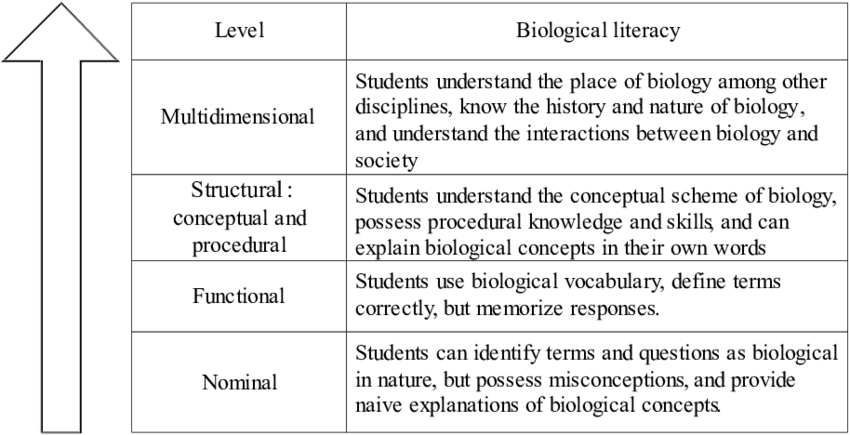
Source: Birzina, Rita. (2011). Biology students’ comprehension of learning as a development of their biological literacy.

Source: Impey, Chris. (2013). Science Literacy of Undergraduates in the United States. Organizations, People and Strategies in Astronomy Vol. 2. 353-364.
“I hate when people confuse education with intelligence, you can have a bachelor’s degree and still be an idiot”. – Elon Musk
There are numerous reasons why individuals may be susceptible to unscientific ways of questioning things. Even the most rational and critically thinking individuals can unintentionally commit a handful of argumentative and logical fallacies [10] on a daily basis, often without even realizing it. While this is perfectly normal, it is important to distinguish between being wrong and being confidently ignorant about incorrect conclusions. That would be in case when one addresses a topic for which:
- Formal education is lacking, and even more importantly, it is scientifically illiterate at the same time.
- Likewise, there are even those who do possess formal education, yet are not immune to logical errors and scientific illiteracy. Even if one passionately reads about specific subjects, without succeeding in comprehending how the general structure of that specific field functions, one is, in every sense, prone to come forth with wrong conclusions or to ignore available research.
There is an extensive array of public figures who sincerely believe in their ability to engage in critical discussions on various topics. However, upon further examination, it becomes apparent that a considerable number of these individuals, along with their followers, often prioritize rhetorical strategies over substantive argumentation. [11]
One fascinating observation is that very few individuals in talk shows or debates actively acknowledge and address their own fallacies in real time. This highlights the remarkable power of persuasive rhetoric, which often has a faster and more immediate impact than well-constructed and thoroughly substantiated arguments. It is not to suggest that these individuals are entirely oblivious to critical analysis or incapable of recognizing underlying phenomena and potential pitfalls – indeed, some are. However, it is all too common for them to rely on flawed premises in their arguments. The key lies in our ability to identify and challenge these fallacies, as well as being self-reflective and open to constructive self-evaluation. By embracing this mindset, we can foster a more intellectually honest and productive discourse. Mastering the art of self-analysis is an extraordinary quest that only a select few can conquer with ease. It demands not just intellectual brilliance, but also an unwavering dedication to personal growth. It is true that even the most brilliant minds can, at times, experience momentary lapses in their real-time self-reflection. However, the true mark of greatness lies in the ability to discern and rectify these occasional fallacies. Such individuals possess a remarkable level of self-awareness and a relentless pursuit of intellectual excellence. It is crucial to understand that labeling someone as an “idiot” for these lapses would be a grave oversimplification. Instead, we should recognize that our educational systems often fall short in instilling a deep understanding of subjects like physics, chemistry, and biology. In these circumstances, fostering a robust level of scientific literacy becomes a paramount necessity. It empowers individuals to grasp fundamental principles about nature and appreciate the vital significance of scientific inquiry. By cultivating such a knowledge base, one can effectively discern between genuine scientific findings and pseudo/anti-scientific claims often misconstrued as scientific in nature.
Now, in today’s world, we often encounter situations where individuals who possess a deep understanding of scientific principles and knowledge mistakenly embrace or promote pseudoscience. This phenomenon is particularly concerning when it involves those who have received a comprehensive education and should know better. Instead of utilizing their expertise to educate others, they succumb to demagoguery and engage in the dissemination of misguided information. This breeds a form of scientific illiteracy that is actively perpetuated, hindering our progress as a society. Sadly, it is often those who rely on their common sense alone that become most susceptible to such narratives.
Even individuals with a firm foundation in core sciences can sometimes find themselves drawn towards “woo” [12] and “new age” movements [13]. There seems to be a concerning issue within educational systems when it comes to science communication. The spread of unfounded claims is often instigated by individuals who portray themselves as “New Age guru-type” figures or motivational speakers [14]. Topics related to the intricate relationship between the body and mind have been significantly impacted, particularly in the wake of the ongoing pandemic. This phenomenon has permeated various scientific disciplines, leaving none unaffected by its mischievous influence. There is an unfortunate presence of certain “well-educated” [15] public figures, including esteemed professors [16] and Nobel Prize laureates, who persistently promote ideas, concepts, and explanations that lack scientific basis. Despite their credentials, they espouse unscientific and unsubstantiated perspectives on our nature and the challenges we face.
Should all highly educated people count as scientifically literate?
The question at hand is a significant one, and it demands a forthright response. In the case at hand, the answer is a resolute “No.” Allow me to elucidate the reasoning behind this conclusion. Individuals, including scientists and scholars, are shaped by their personal worldviews, albeit to varying degrees. In most cases, these personal beliefs do not exert influence over their professional decision-making processes. For instance, when seeking medical assistance, it is uncommon to inquire about a physician’s political or philosophical affiliations. Such matters are typically deemed irrelevant when it comes to the provision of medical care. However, when a healthcare professional begins to intertwine a specific public health issue with politics or adopts unscientific practices their inclination to incorporate pseudoscientific viewpoints into their diagnostic procedures may arise. Consequently, any assertions, claims, or diagnoses made without relying on established scientific consensus should be regarded as speculative and possibly influenced by demagoguery. Academic qualifications, regardless of the field, do not automatically guarantee the absence of deeply ingrained patterns of irrational thinking. Even individuals who have undergone rigorous scientific training may interpret their discoveries through the lens of their ideological beliefs. This phenomenon is not restricted to any specific profession; lawyers, physicians, historians, and individuals from various backgrounds can still embrace unjust practices, unwarranted belief in homeopathy, or engage in historical revisionism. Regrettably, susceptibility to pseudoscience occasionally manages to persist despite years of education and exposure to enlightening knowledge. When coupled with a general aversion to authority, these susceptibilities can have far-reaching consequences. When faced with such a situation, individuals have the tendency to selectively choose [17] and highlight specific data that aligns with their viewpoint, using it as a persuasive tool. This cherry-picking phenomenon is more common than we might realize, occurring both in our own lives and in the broader context around us. An illustrative example is when someone deliberately handpicks a single or multiple studies that support their stance, disregards a much larger body of scientific facts that oppose it, thereby reinforcing their confirmation bias.
In instances like this, it becomes our responsibility to firmly assert, “The scientific method does not function in this manner! [18] One must evaluate and utilize the entirety of a study, or abstain from distorting its findings altogether.”, period! Furthermore, to attain the status of an impartial scientific truth, a study must undergo rigorous peer review. Until such validation is obtained, we can only discuss inclinations or hypotheses tentatively, exercising utmost caution in their public discourse to prevent inaccurate interpretations. Regrettably, this lack of understanding surrounding the scientific process perpetuates widespread misconceptions, necessitating the dissemination of accurate information and clarifications. Science is often perceived by the general public as a dynamic and evolving discipline. This perception leads to the belief that scientific solutions to ongoing problems are frequently revised and may be deemed unreliable. However, although scientific understanding can evolve over time, it is grounded in rigorous methodology and critical thinking. Therefore, it is important to approach scientific findings with careful consideration and understanding, as they provide valuable insights into our world. In the face of the ongoing pandemic, it is imperative to rely on accurate and peer-reviewed studies when discussing important matters such as vaccines and vaccination. Unfortunately, there have been instances where preliminary research has been misused and misinterpreted by individuals claiming to be physicians or scientists. This has led to the propagation of pseudoscientific arguments against vaccination. It is essential to approach such claims with skepticism and seek information from credible sources. In the next sections, we will delve into this issue further.
Science is not inconsistent or wishy-washy in its statements. It adheres to a rigorous process of formulating hypotheses based on acquired data and established laws of nature. Certain claims, such as those suggesting genetic alterations caused by vaccines, are simply impossible and are not considered within the realm of scientific inquiry. However, science is always open to investigating and addressing relevant issues. If a hypothesis is found to be untenable based on new evidence, it is adjusted or refined accordingly. This is the unwavering essence of scientific inquiry. It may be tempting for some to present a different perspective and not overlook the concerning rise of anti-scientific sentiments in society. Merely accepting any bold and unchecked statement, including my own, without thoughtful examination would be an erroneous approach. I would like to believe that humanity’s capacity for discerning plausible scenarios from improbable ones will prevail, as well as our strive to expand our collective knowledge based on sound reasoning, evidence and steering clear of superstition and debunked assumptions.
Developing a scientifically literate way of thinking is not reserved for experts or those with higher qualifications. It is a fundamental skill that should be nurtured during elementary and high school education. While higher education can enhance critical thinking in specific fields, true scientific literacy expands beyond specialized knowledge. It empowers individuals to understand the role of science in society and to confidently apply scientific thinking in their daily lives.
How to identify a scientifically literate and ethical scientist or expert?
When considering the attributes of a genuine and ethical scientist or scholar, it is important to establish certain fundamental touchstones. These touchstones serve as a reliable criterion for identifying individuals who embody the essence of true scientific and scholarly practices. Each one of these touchstones must be met, as their absence might significantly impact the credibility and integrity of a purported scientist or scholar. Allow me to outline these touchstones:
- A true scientist, scholar, or expert refrains from engaging in public discourse regarding proposed claims until thorough investigation and analysis have been conducted.
In the scientific world, it is essential for researchers to seek input and feedback from peers within their field. Peer review plays a crucial role in the validation and refinement of scientific knowledge before it is published.
- One must always substantiate any assertions with verifiable evidence, such as rigorous calculations, empirical tests, or peer-reviewed scientific data.
This could be summarized with Carl Sagan’s words: “Extraordinary claims require extraordinary evidence”. This is where many formally recognized scientists fail, as well as those who consume their claims.
- As a logical consequence of the first point, one never uses public support for claims after they have been proven to be false.
One speaks and writes about a topic after claims were rebuked during the peer-review process, with the intention of attracting new ideologically biased followers and building momentum.
- One never tries to present a non-factual claim as a scientific truth, especially not in conjunctive form, and before the claim has been scientifically analyzed.
In this scenario, a so-called “scientist” typically gathers these so-called “truths” into an esoteric book. When read or heard by someone lacking scientific knowledge, these ideas may appear highly logical and understandable, leading them to perceive it as “valid scientific” information. However, these scriptures usually consist of simplistic, rhetorical nonsense. While it is possible to identify a few thought-provoking questions, the overall content is inundated with unfounded claims and erroneous conjectures.
In the midst of this pandemic, a plethora of what can only be described as “weed literature” has inundated the scene. Its authors boldly accuse legitimate scientists, who diligently explore the reality of the virus and the pressing issues we face, of being part of a nefarious conspiracy. These accusations stretch far and wide, insinuating a plot to dismantle our fundamental rights and more. Curiously, these same authors, devoid of substantial laboratory research, audaciously claim to possess irrefutable data and evidence. Yet, their offerings of viable solutions are woefully lacking, as they propose allowing the unchecked spread of the pandemic. It is worth noting that such historical parallels can indeed be drawn from past pandemics. It is truly fascinating how they have successfully unravelled the mysteries of the universe without physically stepping foot inside a laboratory. Yet, ironically, those dedicated scientists who spend countless hours in such facilities are unjustly accused of dishonesty and overstatement. Such a paradox is nothing short of intriguing!
Some examples are religious organizations that promote Intelligent Design as a scientific theory. The most prominent one in Western cultures is the Discovery Institute. Their “Godfather,” Stephen Meyer, has written several books with pseudoscientific content on this matter.
- Starting an argument by asserting one’s credentials as a scientist or scholar, or by emphasizing multiple titles as a benchmark of seriousness, is not a valid approach [19]
This is a classic argumentative fallacy known as an argumentum ad verecundiam, or an argument from authority. Any claim offered concerning this could be easily ignored because, even if one offers some potentially useful points, they usually lack self-reflection and are overloaded with subtle argumentative discrepancies.[20]
Well then, who are the experts? An expert is a person who, in a specific field, has experienced almost every possible mistake one could foresee or anticipate. It all comes down to the quality of education and the proficiency of the instructors. In reality, many new students, as well as future academicians, may still struggle with cognitive dissonance, confirmation bias, and a tendency towards uncritical thinking [21]
In regards to the preceding topic, it is undeniable that pseudo-scientific reasoning significantly influences the interpretation of natural phenomena by certain scholars. Occasionally, individuals in positions of power may base their decisions on ideological inclinations rather than scientific evidence. Even individuals with a basic understanding of core scientific principles may struggle to detect fallacious and manipulative rhetoric. In such instances, pseudoscientific ideas can appear remarkably persuasive and plausible [22] When it comes to this topic, it is essential to have a method in place to identify not only scientists who may be engaging in unethical practices or lacking scientific literacy, but also to scrutinize and critically evaluate any baseless assertions put forth by such individuals. In this regard, Michael Shermer has presented a valuable resource called the “Baloney Detection Kit,” which offers practical tools for discerning and debunking pseudoscientific claims. You can learn more about it here: Baloney Detection Kit.
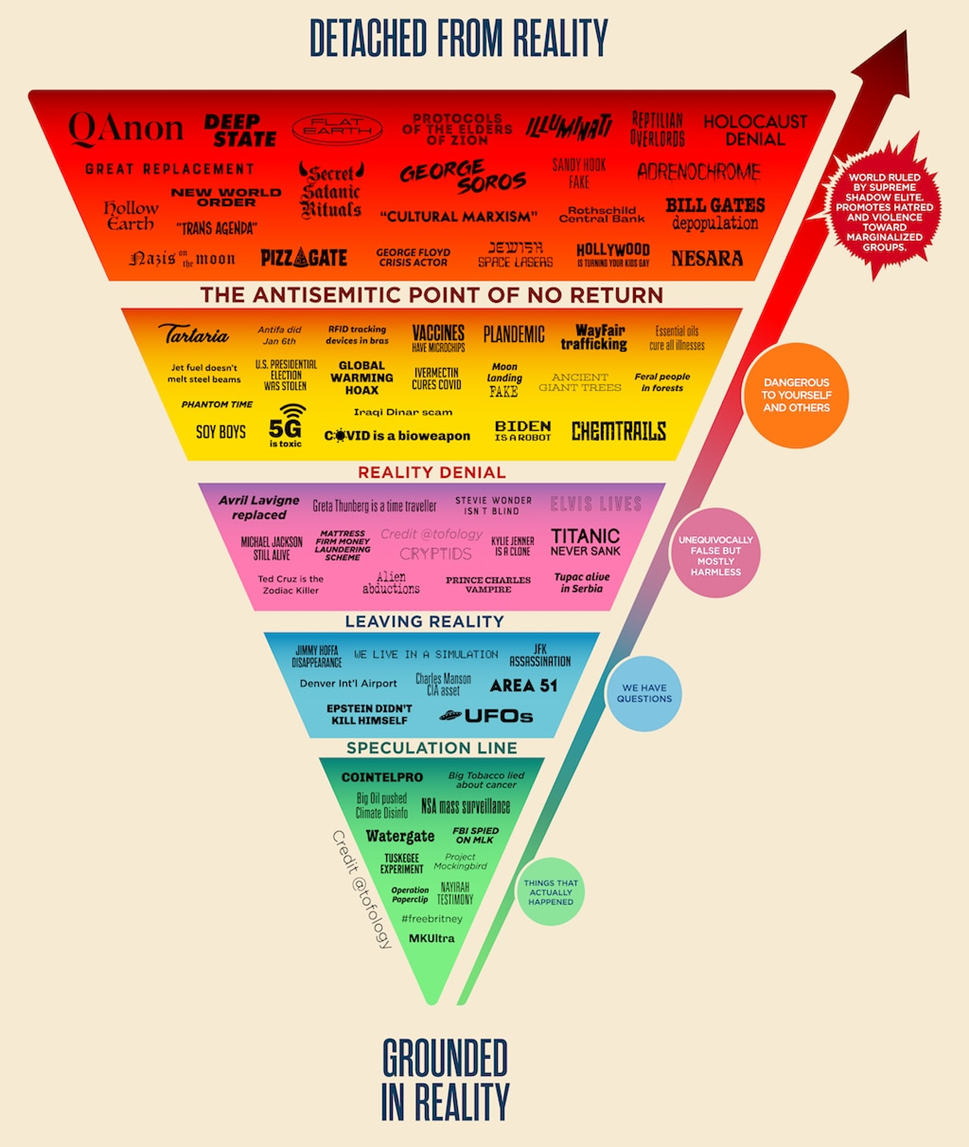
A following graphic, conspiracy chart 2021 [23], shows the steps of cognitive dissonance in respect to specific topic:
Special question concerning social scholars – because there is lot of us!
In regards to the matter of scientific literacy, social scholars often find themselves in a somewhat concerning position. To put it plainly, their stance on this topic tends to be less than satisfactory. Once again, obtaining proficiency in one area of social analysis does not inherently guarantee scientific literacy across all fields. When examining this statement, it is important to consider a fundamental aspect. Scholars in the field of social sciences often analyze phenomena through the lens of their own ideological perspectives and personal values. This approach leads them to ask “why” questions, which delve into the underlying motivations and philosophical implications. On the other hand, individuals with a strong scientific background in the natural sciences, approach their analysis without the need for ideological benchmarks. Their primary concern is to understand the mechanisms and processes that govern a given phenomenon, leading them to ask “how” questions. However, it is worth noting that even here, individuals can still be influenced by ideological confirmation bias and cognitive dissonance, which can impact their assessment of certain claims within a specific scientific subject. Having a strong inclination towards particular worldviews can significantly increase the likelihood of succumbing to argumentative fallacies, particularly in fields where an ideological orientation is unnecessary. For instance, understanding the intricate concepts of how the universe can arise from nothing is a formidable challenge. It requires profound proficiency in mathematics or a deep grasp of the enigmatic realm of quantum mechanics. However, social scholars, though highly knowledgeable in their respective fields, typically do not possess expertise in advanced mathematics or quantum physics. Consequently, their explanations of this phenomenon often carry ideological undertones, including theistic, deistic, or pantheistic perspectives. Allow me to share a fascinating analogy proposed by the esteemed physicist Stephen Hawking, which beautifully encapsulates the idea of nothingness: “To help you get your head around this weird but crucial concept, let me draw on a simply analogy. Imagine a man wants to build a hill on a flat piece of land. The hill will represent the universe. To make this hill he digs a hole in the ground and uses that soil to dig his hill. But of course he’s not just making a hill – he’s also making a hole, in effect of a negative version of the hill. The stuff that was in the hole has now become a hill, so it all perfectly balances out. When a Big Bang produced a massive amount of positive energy, it simultaneously produced the same amount of negative energy. In this way, the positive and the negative add up to zero, always. It’s another law of nature. So where is all this negative energy today? It’s in the third ingredient in our cosmic cookbook: it’s in space. … I’ll admit that, unless mathematics is your thing, this is hard to grasp, but it’s true.”[24]
In the following sections, I will discuss specific cases as showcases of scientific illiteracy.
Next part: THE CLAIM: “SPACE EXPLORATION IS NOT IMPORTANT” as a showcase of science illiteracy – (Pt.2/3)
[1] Our history recollects many pandemic events and this one is surely not the last one.
[2] Like in the well-known comedy “Idiocracy”.
[3] Basic level would be at least a possession and proper understanding of elementary and high school education in physics, chemistry and biology, but also possessing a general ability to dissent plausible from implausible assertions, probabilities, comparisons, as well as being able to form logically connected follow-up questions.
[4] According to one of many possible definitions, an amateur scientist is: “One who is a scientific investigator as a pastime rather than a profession.” Body (madscitech.org); (re)acquired on 01.12.2021
[5] Stephen Hawking: A brief history of time (New York, Bentam books; 2017); p.18
[6] https://study.com/academy/lesson/scientific-literacy-definition-examples.html
[7] ANTON PETROV – MATH & SCIENCE TEACHER – Home (weebly.com); last time acquired 07.01.2021
[8] Surprising Ways How Life Is Adapting To Plastics On Planet Earth – YouTube; last time acquired 07.01.2021
[9] Great stand-up comedian and philosopher, George Carlin, has vividly and in funny way explained our role in nature (a part of the transcript I simply had to repost):
“See, I’m not one of these people who’s worried about everything. You got people like this around you? Countries full of them now: people walking around all day long, every minute of the day, worried… about everything! Worried about the air; worried about the water; worried about the soil; worried about insecticides, pesticides, food additives, carcinogens; worried about radon gas; worried about asbestos; worried about saving endangered species. Let me tell you about endangered species all right? Saving endangered species is just one more arrogant attempt by humans to control nature. It’s arrogant meddling; it’s what got us in trouble in the first place. Doesn’t anybody understand that? Interfering with nature. Over 90% – over, WAY over – 90% of all the species that have ever lived on this planet, ever lived, are gone! Pwwt! They’re extinct! We didn’t kill them all, they just disappeared. That’s what nature does. They disappear these days at the rate of 25 a day and I mean regardless of our behaviour. Irrespective of how we act on this planet, 25 species that were here today will be gone tomorrow. Let them go gracefully. Leave nature alone. Haven’t we done enough?
We’re so self-important, so self-important. Everybody’s gonna save something now: “Save the trees! Save the bees! Save the whales! Save those snails!” and the greatest arrogance of all: “Save the planet!” What?! Are these fucking people kidding me?! Save the planet?! We don’t even know how to take care of ourselves yet! We haven’t learned how to care for one another and we’re gonna save the fucking planet?! I’m getting tired of that shit! I’m getting tired of that shit! I’m tired of fucking Earth Day! I’m tired of these self-righteous environmentalists; these white, bourgeois liberals who think the only thing wrong with this country is there aren’t enough bicycle paths! People trying to make the world safe for their Volvo’s! Besides, environmentalists don’t give a shit about the planet. They don’t care about the planet; not in the abstract they don’t. You know what they’re interested in? A clean place to live; their own habitat. They’re worried that someday in the future, they might be personally inconvenienced. Narrow, unenlightened self-interest doesn’t impress me.
Besides, there is nothing wrong with the planet… nothing wrong with the planet. The planet is fine… the people are fucked! Difference! The planet is fine! Compared to the people, THE PLANET IS DOING GREAT: Been here four and a half billion years! Do you ever think about the arithmetic? The planet has been here four and a half billion years, we’ve been here what? 100,000? Maybe 200,000? And we’ve only been engaged in heavy industry for a little over 200 years. 200 years versus four and a half billion and we have the conceit to think that somehow, we’re a threat? That somehow, we’re going to put in jeopardy this beautiful little blue-green ball that’s just a-floatin’ around the sun? The planet has been through a lot worse than us. Been through all kinds of things worse than us: been through earthquakes, volcanoes, plate tectonics, continental drifts, solar flares, sunspots, magnetic storms, the magnetic reversal of the poles, hundreds of thousands of years of bombardment by comets and asteroids and meteors, worldwide floods, tidal waves, worldwide fires, erosion, cosmic rays, recurring ice ages, and we think some plastic bags and aluminum cans are going to make a difference?
The planet isn’t going anywhere… we are! We’re going away! Pack your shit folks! We’re going away and we won’t leave much of a trace either, thank God for that… maybe a little styrofoam… maybe… little styrofoam. The planet will be here, we’ll be long gone; just another failed mutation; just another closed-end biological mistake; an evolutionary cul-de-sac. The planet will shake us off like a bad case of fleas, a surface nuisance. You wanna know how the planet’s doing? Ask those people in Pompeii who are frozen into position from volcanic ash how the planet’s doing. Wanna know if the planet’s all right? Ask those people in Mexico City or Armenia or a hundred other places buried under thousands of tons of earthquake rubble if they feel like a threat to the planet this week. How about those people in Kilauea, Hawaii who build their homes right next to an active volcano and then wonder why they have lava in the living room?
The planet will be here for a long, long, LONG time after we’re gone and it will heal itself, it will cleanse itself cause that’s what it does. It’s a self-correcting system. The air and the water will recover, the earth will be renewed, and if it’s true that plastic is not degradable, well, the planet will simply incorporate plastic into a new paradigm: The Earth plus Plastic. The Earth doesn’t share our prejudice towards plastic. Plastic came out of the Earth! The Earth probably sees plastic as just another one of its children. Could be the only reason the Earth allowed us to be spawned from it in the first place: it wanted plastic for itself, didn’t know how to make it, needed us. Could be the answer to our age-old philosophical question: “Why are we here?” PLASTIC!!! ASSHOLES!!!”; George Carlin: Saving the Planet – Full Transcript – Scraps from the loft
[10] Those who have formal debating experience, in any extent, will understand the point I am trying to make. To those who lack it, I recommend to visit following link, where few very informative things about debate, as well es the main list of logical fallacies could be found: Glen Whitman’s Debate Page (csun.edu); last time acquired 05.12.2021
[11] An article about fallacious argumentation: A Populist Writer and Critic – How Intellectual Bogus Leader Richard D. Precht Misleads Us Once Again with Nonsensical Arguments, this Time on Corona | Lars Jaeger; last time acquired 05.12.2021
[12] https://rationalwiki.org/wiki/Woo; last time acquired 08.12.2021
[13] https://rationalwiki.org/wiki/New_Age; last time acquired 08.12.2021
[14] Just to name a few:
https://rationalwiki.org/wiki/Oprah_Winfrey ;
https://rationalwiki.org/wiki/Eckhart_Tolle ;
https://rationalwiki.org/wiki/David_Icke ;
https://rationalwiki.org/wiki/Gwyneth_Paltrow ;
all last time acquired 08.12.2021
[15] Just to name a few:
https://rationalwiki.org/wiki/Bruce_Lipton ;
https://rationalwiki.org/wiki/Deepak_Chopra ;
https://rationalwiki.org/wiki/Jordan_Peterson ;
https://rationalwiki.org/wiki/Andrew_Wakefield ;
https://rationalwiki.org/wiki/Vandana_Shiva;
Dr. Steven Gundry | Goop (is part of the https://rationalwiki.org/wiki/Gwyneth_Paltrow group)
all last time acquired 08.12.2021
[16] E.g. Sucharit Bhakdi, Geert Vanden Bossche; More about it here:
English Version: Scientists opposing Corona measures – The Line between Healthy Scientific Scepticism and providing support to the absurd QAnon movement | Lars Jaeger; ; last time acquired 08.12.2021
German Version: Wissenschaftler als Gegner von Corona-Massnahmen – Der Grat zwischen gesunder wissenschaftlicher Skepsis und Unterstützung der absurden Querdenker-Bewegung | Lars Jaeger; last time acquired 08.12.2021; here as well; Famous Doctors and Their Dangerous Disinformation (digicomnet.org); ; last time acquired 08.12.2021
[17] Cherry-picking is one of the most prominent and most used argumentative fallacy.
[18] In this respect I would strongly recommend a following interview with Neil DeGrasse Tyson: https://www.bbc.co.uk/sounds/play/w3ct1n6t or https://www.youtube.com/watch?v=qIXPj1TFz-g; last time acquired 30.12.2021
[19] In certain European countries, academic titles hold great significance, symbolizing both seriousness and social status. This cultural tradition can be traced back to the historical context of monarchy and aristocracy. With the transition to republics, academic titles took on the role of replacing the old aristocratic titles and thus gained high social importance. In some cases, the pursuit of multiple titles became more of a cultural phenomenon rather than a genuine thirst for knowledge and scientific enlightenment. Consequently, it is not uncommon to come across individuals adorned with numerous title abbreviations, such as MMag. DDDr., signifying multiple magister and doctorate degrees. While it is true that this has led to the rise of “title careerists,” it is important to acknowledge that there are still many academics who possess genuine scientific knowledge and expertise. However, differentiating between the two can often be challenging, as some title careerists occupy influential positions and even gain recognition as national intellectuals, despite promoting pseudoscientific ideas.
[20] For instance, Jordan Peterson is a highly influential figure who often employs the argumentum ad verecundiam fallacy in his arguments. Despite any potential shortcomings, he has managed to garner a significant following. This can be attributed to his reputation as a skilled rhetorician who seems to possess all the answers. In a world where time is a precious commodity, many individuals find solace in turning to charismatic figures like Mr. Peterson, who claim to have unraveled complex subjects. However, it is crucial to recognize that these individuals often package and sell their own biases under the guise of truth and secret knowledge. This relieves the audience of the responsibility to engage in critical thinking. While some may hastily label Mr. Peterson as a far-right winger, it is important to note that he operates more within the center-right spectrum, nostalgically longing for a bygone era. Nostalgia for the past is a prevalent inclination within conservative ideologies, albeit also present in certain left-wing circles. Through his public appearances and interviews, Mr. Peterson has expressed his admiration for Dostoevsky, an unwavering belief in the perfection of capitalism, and a view that hierarchies are inherently ingrained through evolution. He has also made controversial statements regarding the preferences of women, their suitability for leadership roles due to inherent maternal instincts, and the intelligence of people of color. It is quite remarkable how he manages to display such a shallow grasp of philosophy and history. One cannot help but question the legitimacy of his criticisms, especially when it comes to subjects like postmodernism. The way he casually tosses around terms like “postmodern neomarxism” reveals a lack of intellectual depth. It is truly baffling how he expects his audience to understand and engage with such jargon, when even he himself seems to struggle with their meanings. As for his notion of truth, it appears to be nothing more than a feeble attempt to pander to the biases of his audience, rather than offering any meaningful or objective insights. Peterson’s views have often been criticized for their lack of rationality and honesty. His attempt to reconcile his religious beliefs with reality has led to contradictory worldviews. Despite presenting himself as an authority on various subjects, Peterson’s epistemic views are regressive and hinder intellectual progress.
[21] Caused by any ideological influence (mostly, religious type spiritualism; old or new) or by misunderstanding of natural processes, where the level of available skepticism does not allow questions about own convictions and knowledge.
[22] E.g. correcting the damage caused by Andrew Wakefield and his claim that vaccines are causing autism never ended. It also reignited anti-vaccination movement, which plagues the global vaccination efforts in many areas.
[23] https://conspiracychart.com/
[24] Stephen Hawking: Brief answers to the big questions (London, John Murray (publishers); 2020); pp.32-33.
 Scientifically Literate Junction
3 thoughts on “(OUTDATED VERSION) SCIENTIFIC (IL)LITERACY AND ITS SOCIAL CONSENQUENCES (Pt.1/3)”
Comments are closed.