To those unfamiliar with Hossenfelder, here is a brief description: She is a physicist and YouTuber known for debunking pseudoscience and similar topics. Her sharp, often justified science critiques and dry humor have earned her online fame. She is seen by her followers, and perhaps herself, as a science communicator, a role typically viewed positively. However, there are issues with this perception. The main problem is that Hossenfelder’s rhetoric and the depth of her analysis have shifted over time. Simultaneously, she seems to have developed a peculiar grudge against a specific groups of physicists or fields of physics. Her overall messaging and rhetoric are sometimes inconsistent, which is problematic for someone who aims to act as a genuine science communicator.
In this text, I will try to elaborate on these points, but I want to first highlight that Hossenfelder does introduce interesting ideas to the general conversation on physics, and these should be taken seriously. However, the way she communicates often reminds me of figures like Eric and Brett Weinstein, who present themselves as “honest” science critics but harbor a clear grudge against the scientific establishment. They seize any opportunity to criticize it. For a deeper understanding of this tactic, watch Professor Dave Explains’ debunking video on these highly educated charlatans (an oxymoron, I know). For example, Eric Weinstein once claimed he had discovered the mathematical answer to the theory of everything, dubbed “geometric unity.” His hypothesis was ignored due to its flaws, but he couldn’t accept this, and began subtly spreading the idea that science had lost its ethical and scientific compass. This is a familiar self-positioning tactic, reminiscent of the biblical “David and Goliath” story, where the narrative goes, “I, the underdog, am fighting the big establishment.” Their rhetoric pushes the false narrative that anything mainstream is inherently bad or wrong. Eventually, Eric and Brett drifted into pseudoscientific rabbit-hole. Despite their critiques, they avoid calling out genuine grifters and pseudoscientists, as their views overlap with these groups, even when they remain superficially within the scientific realm. While Hossenfelder doesn’t go quite this far (as of now), she aligns with Weinstein on some points, such as dismissing string theory almost as pseudoscience.
Interestingly, this attitude seemed to intensify after she struggled to secure research funding, and her disdain for specific fields of physics became more pronounced. This mirrors Eric Weinstein’s reaction to rejection. For me, this was one of several red flags that led me to conclude that Hossenfelder lacks the qualities of a true science communicator. She might excel in other areas, but regrettably, her science communication of late is not one of them. For those who think this is a weak argument, I will offer more specific examples to demonstrate how Hossenfelder’s rhetoric, narrative, and hypocrisy reveal a troubling dishonesty in her approach.
Grudge against String theory
Hossenfelder and some of her followers harbor significant animosity toward scientists working on string theory (which, to be precise, should probably be called the string hypothesis) and even toward particle physicists. Her main argument, roughly paraphrased, is this: String theory leads nowhere because it cannot be tested, and therefore it should be abandoned. Those who continue working on it are misusing grants meant for “real” research, promoting pseudoscience, and profiteering from this work.
Point One: “The theory is currently leading nowhere because it cannot be tested, so it should be abandoned.”
It is true that string theory cannot be directly tested, and even some indirect tests are questionable. However, to claim we will never find a way to test the hypothesis is an equally false claim. This certainty Hossenfelder presents is an absolute argument, combined with an argument from authority, both of which are logical fallacies. This should raise red flags for anyone who understands the implications of such a position. Hossenfelder argues that all hypotheses should be backed by facts and testable predictions within a “reasonable” timeframe. The timeframe, that she would say it is needed. That’s fine, but this claim overlooks the fact that many scientific breakthroughs began as speculative ideas and often hinge on practical constraints, such as the availability of the technology required for testing. Scientific progress frequently starts with intuition or gut feelings. While some ideas stray into pseudoscience (like Rupert Sheldrake’s) despite having the technology for proper experimentation and offering neither mathematical models nor reliable explanations, relying instead on suggestive behavior, other ideas evolve into robust models, at least within a formal mathematical framework. Even if we never develop a way to test string theory, the mathematical framework behind it has already contributed to refining our understanding of the physical world. Scientific progress often starts with what we have at our disposal, and string theory emerged from the tools and knowledge available at the time.
History is filled with mathematical problems that remained unsolved for centuries (Unsolved Problems) yet no one dismissed them as fruitless endeavors. If we followed Hossenfelder’s thinking, we would have abandoned many areas of research that eventually bore fruit. The reality is that some mathematical problems are proven while others are disproven (Solved Problems), which helps us become more confident in our ability to better understand newly resolved areas of mathematics. In the same way that mathematical problems can be proven or disproven, so can any hypothesis. Until that point, anyone with the energy and determination to pursue such an endeavor should not be discouraged. Real science communicators encourage exploration, even of difficult or speculative ideas. Yet, from Hossenfelder’s videos, I sense more discouragement than inspiration, which is at odds with the role of a true science communicator.
Point Two: “People who work on string theory are misusing grants.”
Her general claim about the grants provides no actual evidence, serving only to slander an entire community of individuals who have dedicated their lives to unraveling the most complex aspects of our physical existence. The vast majority of these people embarked on this journey with genuine aspirations, and many remain sincerely motivated by the belief that they can solve the problems within string theory. Are there some who might abuse the system? Yes, of course, such individuals can be found in every scientific field. However, that doesn’t mean the entire group or the discipline as a whole is made up of dishonest individuals. For the record, pseudoscientific groups operate on a completely different level. This whole situation reminds me of creationist chemist James Tour and his claims about researchers working in abiogenesis and the origin of life (OOL). But more on that comparison below.
Point Three: “String theorists are promoting pseudoscience and aren’t real scientists.”
Her main claim is that they often use non-physicist language in their public speeches and give the impression that string theory is an indisputable theory. However, if you’re a science communicator aiming to inspire people to take up physics, chemistry, or other sciences, you need to make complex ideas accessible and engage your audience without resorting to non-topical cynicism or excessive sarcasm. This is a rare skill, and unfortunately, Hossenfelder seems to be one of those who doesn’t possess it. I honestly hope that I am wrong about this conclusion. Anyway, inspiring someone who has never properly engaged with science to do so is not related to pseudoscience. Moreover, string theorists involved in science communication don’t focus solely on string theory; they discuss a wide range of topics within physics and have never presented string theory as a finished or flawless theory. Those who have read their books or listened to their talks have also heard them outline the many issues that make string theory problematic and not yet fully viable. They also express profound respect for the scientists who provided the tools and ideas to help us better understand physical reality. This general admiration for the scientific process is something missing from her narrative.
Hossenfelder’s latest click-bait video about Brian Greene highlights her misunderstanding of what he aims to achieve as a science communicator. Her videos frequently feature titles with terms like “nonsense” or “pseudoscience” when addressing string theory. If she later realizes that calling a fellow scientist’s work “pseudoscience” was excessive, she swaps the word for something less severe, like “nonsense”, sometimes on the same day. She tends to point out the obvious and disparage the string theory community, presenting her personal beliefs as established facts about why string theorists “do this or that.”
In contrast, consider the respectful and appreciative discussions between Brian Greene and Roger Penrose. Sir Penrose isn’t particularly fond of string theory either, but he understands how scientific endeavors work and doesn’t attack legitimate scientists who, while holding different ideas, remain firmly within the realm of science and mathematics. Hossenfelder’s obsession with lumping Greene and other non-grifting scientists and science communicators into the same category as true pseudoscientists is remarkable.
Point Four: “String theorists are grifters who use online platforms to profit.”
Hossenfelder should focus on the real grifters, particularly those in Europe, and take notes from YouTubers like Professor Dave, Conspiracy Toonz, Debunk the Funk, and Anton Petrov on how science communication should be done without damaging her own credibility. For example, Professor Dave is very direct in his language, even more so than Hossenfelder, but he doesn’t present his personal opinions as factual statements. That’s a big difference! Despite his bluntness, he still manages to inspire people to engage with science by emphasizing how it has helped humanity overcome countless challenges throughout history. That’s always his central theme. As mentioned earlier, the “vibe” from Hossenfelder’s videos is quite the opposite. If I were a young person without a solid understanding of science and came across Hossenfelder’s videos first, the chances of being inspired to pursue science would be slim. Any science communicator who predominantly cannot inspire others to explore science isn’t truly a science communicator. They may be something else, but not a science communicator.
Returning to her claim: Most of the people involved in string theory are from older generations who established their careers long before the rise of online platforms in recent years. While they do use both online and offline platforms, their focus is on science communication and the exchange of scientific information. During the pandemic, I enjoyed Brian Greene’s Your Daily Equation crash course series because it broke down complex concepts for a non-mathematical audience and inspired further reading. Once again, Hossenfelder doesn’t offer anything like this, no crash courses or webinars. Professor Dave has entire playlists covering topics in physics, chemistry, and biology, designed as learning tools for graduate and postgraduate students, while simultaneously debunking pseudoscience and legitimate pseudoscientists on a massive scale. When it comes to grifting, it seems Hossenfelder may have found a way to keep one foot in the scientific realm while appealing to an audience that is suspicious of authority and prone to conspiratorial thinking. Whether this is a planned goal is hard to say. Either way, it is not an honest approach to science communication. I sincerely hope she will reassess her approach.
However, she is not the first person to try to “sit with one butt on two chairs.” Brian Keating is another example. As an astronomer, he seems rational, but whenever someone asks him a question linking creationism with science, he evades giving a direct answer. That raises a red flag about whether someone is truly a science communicator. Even non-scientists like YouTuber Conspiracy Toonz have professionally and with respect debunked some of Hossenfelder’s claims concerning 5G technology. Afterward, he invited her to respond to the debunking, but she never replied. So, if someone is grifting and using an online platform to boost their prominence, it might be Hossenfelder, not her fellow string theory scientists.
Narrative and Method
There are highly educated individuals (some physicists among them, though far from all) who find Hossenfelder’s style refreshing and see her as an effective science communicator. While it’s fine to find her refreshing, we must not forget the significant difference between an audience that engages with science daily and those encountering the scientific world for the first time or only at a basic level. The latter group needs a science communicator who doesn’t introduce unnecessary misunderstandings. Like some very odd video titles that suggest, as if science has lost its way, such as these:


In this case, the reason the scientific community eventually uncovers fraud is due to science’s idiotic built-in, self-correcting system known as the scientific method. Scientific fraud has always been part of the scientific landscape, but we inevitably discover it over time. The more significant a topic is, the faster any falsehoods are debunked. Pointing out that scientific fraud exists, while implying it is something new, reflects either a fundamental misunderstanding of how the scientific method works or a deliberate misrepresentation for dishonest clickbait purposes. In any case, I don’t care if her actual content contradicts the video titles, framing the title as clickbait (in bad faith) is neither honest nor constructive in science communication. Those who can analyze her statements on a professional level may either support her views with reasoned arguments or oppose them based on their expertise. However, for the majority who are not actively involved in science or are scientifically illiterate, her views are often accepted at face value, reinforcing pre-existing confirmation biases, especially if those are of a conspiratorial kind.
For instance, some of Hossenfelder’s videos on topics like climate change have been appealing to climate change deniers because she introduces additional skepticism into an area that already requires a balanced, well-founded skepticism. By doubling down on doubt, she amplifies conspiratorial undertones, making climate science appear more uncertain than it is and climate scientists seem like disoriented fools. Her frequent releases, which sometimes flip-flop in narrative direction, only add to the confusion. Fortunately, other genuine climate science communicators address the same topics in a less sarcastic, more grounded way, actively debunking the misconceptions Hossenfelder needlessly introduces.
Her constant shifts, adjustments, and fine-tuning of claims seem to stem from a methodical impatience with how we should incorporate new data into the broader picture. She appears restless, eager to point out that fresh data suggests something different, often presenting it as a paradigm-shifting truth that overturns all previous knowledge. While she doesn’t present false data, her interpretations can sometimes be flawed, or she may give new data undue importance. Many science communicators from various specialized fields have begun to review or to correct Hossenfelder’s explanations and suggestions.
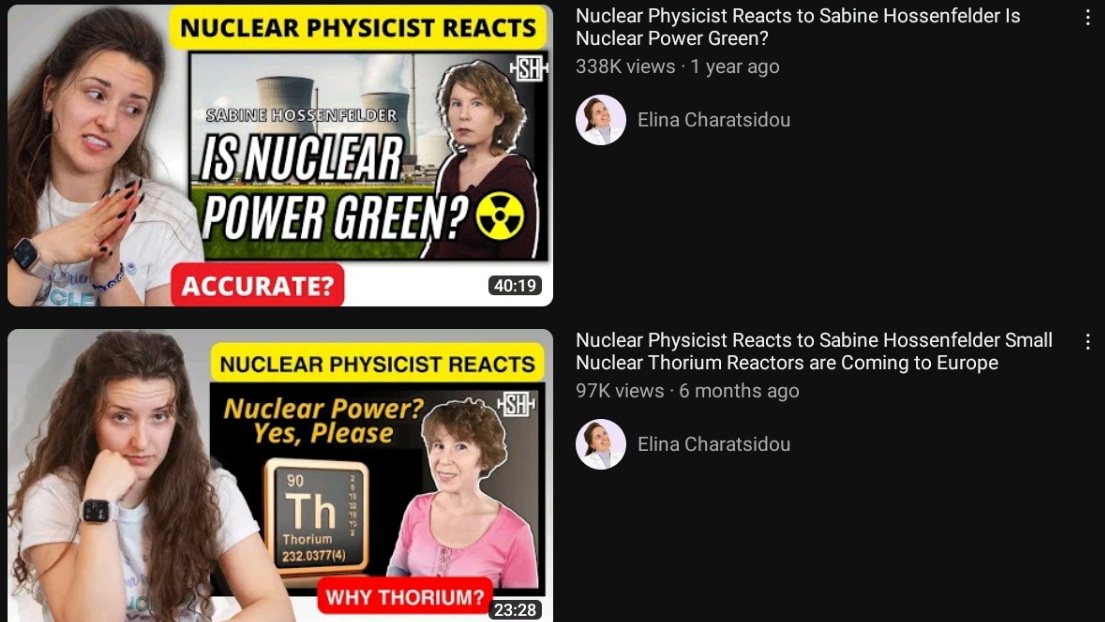
When she criticizes specific fields of physics, it echoes the criticisms creationists use against origin-of-life (OOL) research. Every time she claims that e.g. string theorists adjust their hypotheses and calculations to make the theory work without hard experimental evidence, it resembles James Tour’s argument that “gaps in exact data” render the idea of abiogenesis false. (More on this chemist charlatan can be found in Professor Dave’s creationist debunking series. Tour is a perfect example of how highly educated individuals can still propagate pseudoscience by grifting into areas, such as anti-vaxx rhetoric, pandemic conspiracy theories, virus denial, and evolution denial. If you ask me, one of the saddest things is that her rhetoric is reminiscent of Tour or Weinstein, even though, as a scientist, Hossenfelder is light-years ahead of people like them.
Additionally, a growing number of scientists respect Hossenfelder’s intellect but reject her specific type of click-baiting and subtle anti-science rhetoric. These voices (1) point to the very issues I’ve already mentioned. Many of them are legitimate, active scientists who have attempted to contact her to address the misinterpretations or misunderstandings in her statements or writings. However, she either blocks these individuals or simply ignores them.
Just take following topic for example:
These screenshots are from same video.
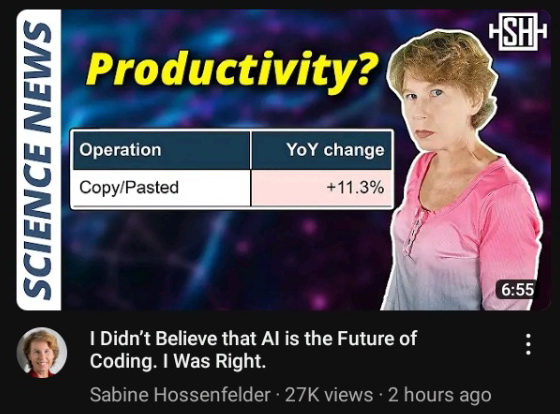

…and then a comment from someone who addresses the crucial nuances that Hossenfelder failed to grasp, despite her self-proclamation of “I was right”:
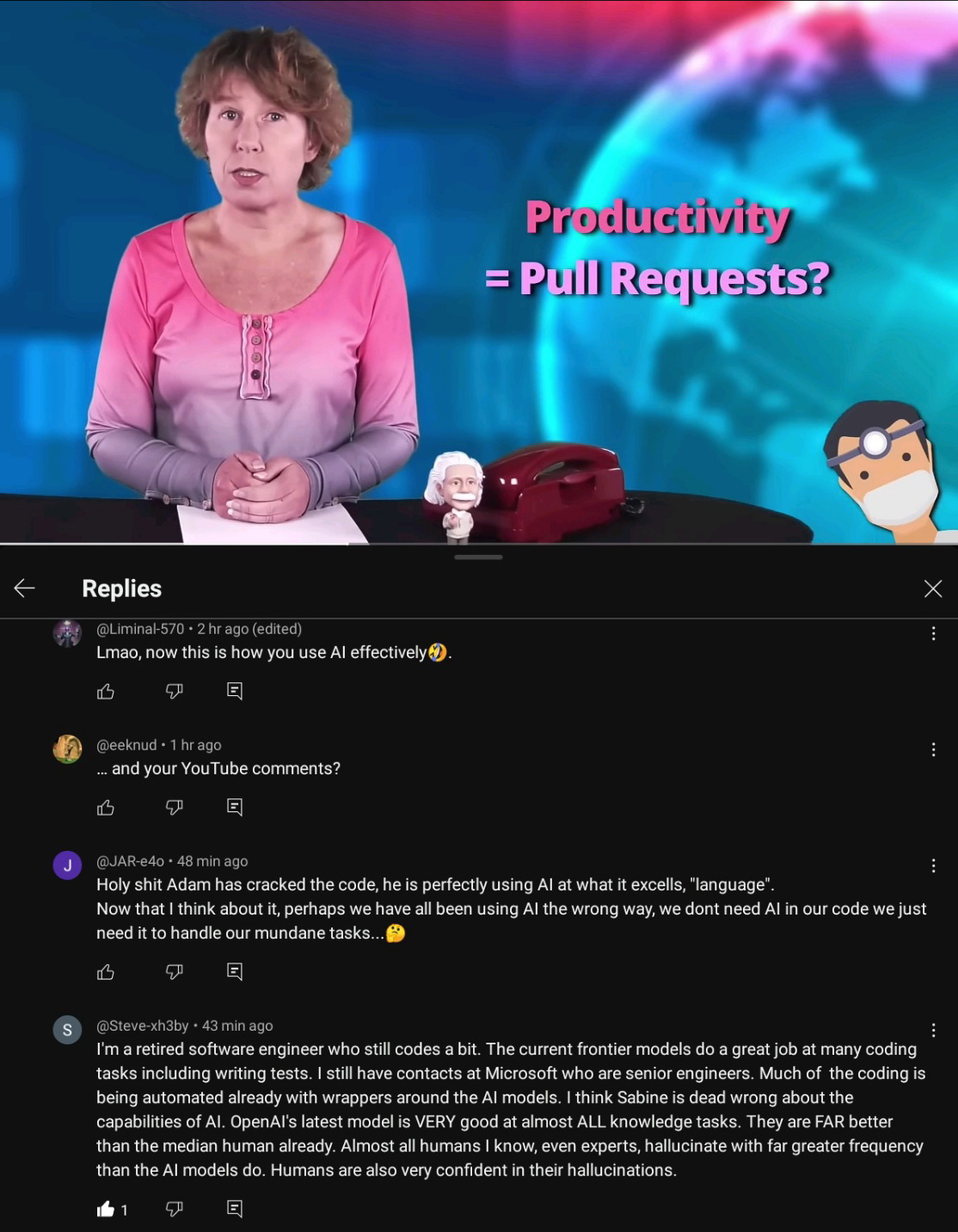
This is certainly not how a scientist or a science communicator should behave, especially someone who tries to present herself in that role while portraying others in a negative light. If she directed this behavior toward genuine grifters and promoters of pseudoscience, like John Campbell, the Weinstein brothers, Rupert Sheldrake, Sucharit Bhakdi, or Robert Malone, it would be much easier to understand. But that is not the case. We shouldn’t be surprised if she’s excluded from more prominent science platforms in the future (if that hasn’t already begun). If you disparage legitimate scientists colleagues who are doing everything to stay true to scientific method out of personal grudge or arrogance, it’s no wonder you might be disinvited, not because you’re speaking the truth, but because you position yourself as the sole truth-teller, branding others as pseudoscientists a priori! But guess who will be blamed for that? The corrupt scientific establishment, of course, the great Goliath! Even casual science enthusiasts like myself are beginning to see through Hossenfelder’s rhetoric and her subtle anti-science stance (though she would likely reject this characterization). Many are no longer considering her as legitimate science communicator or educator.
So, what is she? A philosopher of science? A communicator? A science presenter? An educator? Her rigid personal opinions, combined with an overuse of sarcasm and cynicism, aren’t great foundations for any of these roles. For philosophy of science, there are far better options, like Daniel Dennett, a true philosopher of science who, sadly, passed away recently. As for science communicators and educators, there are others like Professor Dave or Debunk the Funk, who effectively address pseudoscience in a manner similar to Hossenfelder but without the constant need to disparage legitimate science communicators in specific niches like Brian Greene and their peers for the sake of viewership. Anton Petrov is another excellent science presenter who, like Hossenfelder, covers similar topics but without excessive sarcasm and with great admiration for science and the scientific method. Hossenfelder is certainly not like James T., the Weinstein brothers, or Rupert S., she is far more credible than those charlatans. However, her narrative and subtle anti-science messaging can sometimes undermine her ability to be seen as a truly reliable, non-grifting science educator. Personally, her new approach feels akin to that of a modern science news anchor someone who adds a dash of “salt and pepper” to spark debate and provoke controversy. Of course, Hossenfelder’s fans would probably disagree. Then again, maybe I’m wrong too, we will see!
(1) – How-do-theoretical-particle-physicists-respond-to-Sabine-Hossenfelders-How-Popper-Killed-Particle-Physics OR Why does Sabine Hossenfelder and some other authors attack speculative ideas in physics. Is she and others not guilty of that herself?
 Scientifically Literate Junction
One thought on “SABINE HOSSENFELDER – A GOOD SCIENCE COMMUNICATOR?”
Comments are closed.